Build vs. Buy: A Decision Framework for AI Implementation
When to use off-the-shelf tools, when to customize, and when to build from scratch. A practical framework based on complexity, competitive advantage, and capability.
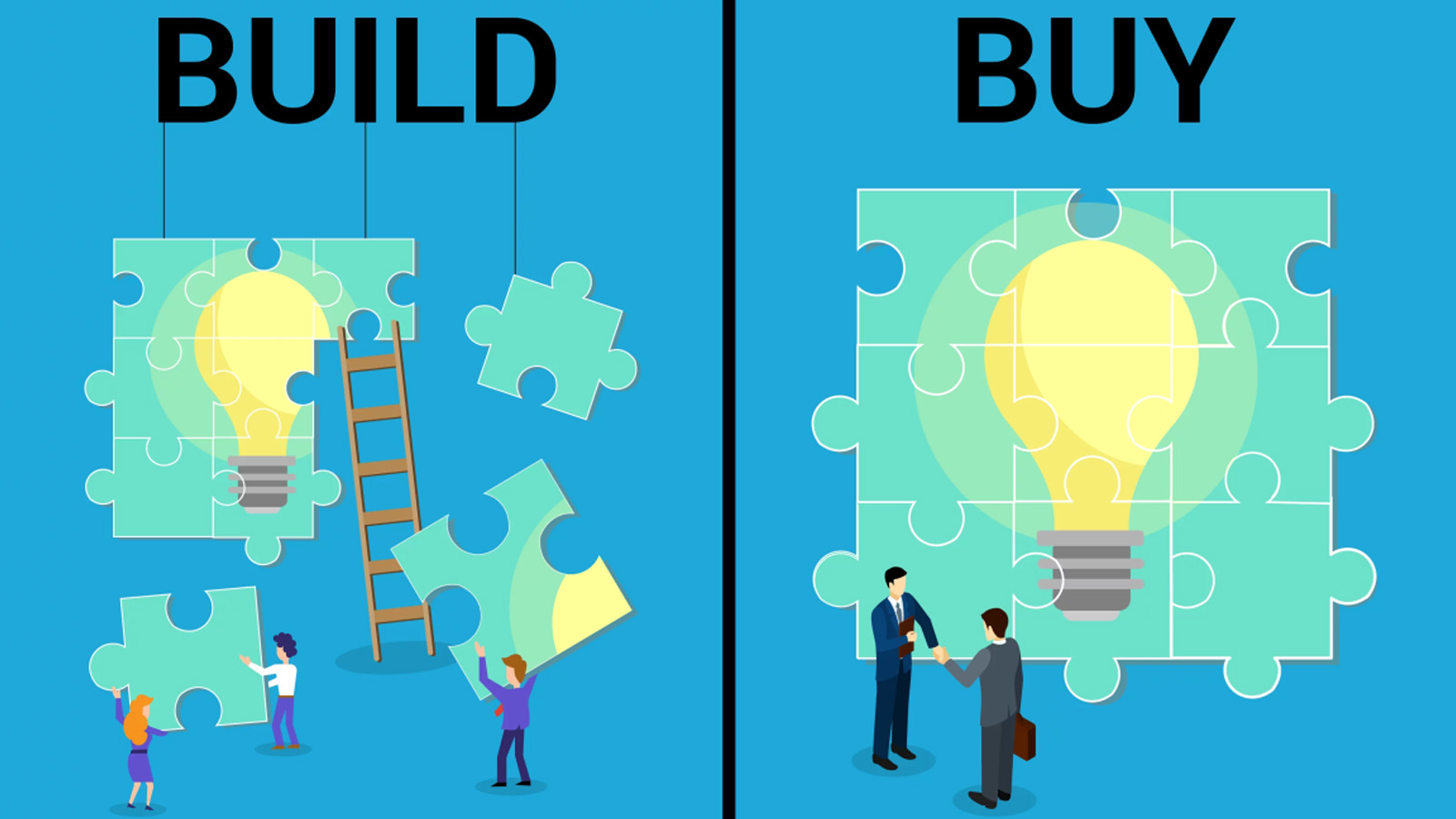
"Should we build or buy?"
I hear this question in almost every initial conversation. And the honest answer is always the same: it depends. But it depends on specific, identifiable factors—not gut feel or vendor pressure or what your competitor did.
There are three paths: buy off-the-shelf, customize an existing platform, or build from scratch. Each has real tradeoffs. None is universally correct. The right choice depends on your use case, your competitive position, and your team's capability.
Here's how to think through it.
The Three Paths
Before we get to the decision framework, let's be clear about what each option actually means.
Path 1: Buy Off-the-Shelf
You use a product as-is. Maybe it's a SaaS tool with AI baked in. Maybe it's an API you call with minimal integration work. The point is: you're using someone else's solution with little to no customization.
Examples:
- Adding Grammarly to your writing workflow
- Using Jasper or Copy.ai for marketing content
- Integrating a pre-built chatbot like Intercom's Fin
- Using transcription services like Otter.ai
What you get:
- Fast time to value (days or weeks, not months)
- Low upfront cost
- Vendor handles maintenance, updates, improvements
- Proven solution with existing users
What you give up:
- Customization limited to what the vendor offers
- Your competitors can buy the same thing
- You're locked into the vendor's roadmap
- Data may leave your environment
- Pricing scales with usage (can get expensive)
Path 2: Customize
You start with a platform, framework, or foundation model, then build on top of it. You're not starting from zero, but you're doing real development work to make it fit your needs.
Examples:
- Fine-tuning an open-source model on your data
- Building a custom application on top of OpenAI or Anthropic APIs
- Using a low-code AI platform with custom workflows
- Implementing RAG (retrieval-augmented generation) with your documents
What you get:
- Tailored to your specific use case
- Faster than building from scratch
- Can create meaningful differentiation
- More control over behavior and outputs
- Can keep data in your environment
What you give up:
- Requires real development work
- Ongoing maintenance becomes your responsibility
- Dependent on the underlying platform's capabilities and pricing
- Need people who understand both the platform and your domain
Path 3: Build from Scratch
You're training models, building infrastructure, creating something that doesn't exist. This is rare and usually wrong—but sometimes it's the only path that makes sense.
Examples:
- Training a custom model for a highly specialized domain
- Building proprietary AI for a core product differentiator
- Creating infrastructure when no existing solution fits regulatory requirements
- Developing novel AI capabilities that don't exist in the market
What you get:
- Complete control
- Maximum differentiation (competitors can't buy this)
- No vendor dependencies
- Can be a core asset and competitive moat
What you give up:
- Massive investment (time, money, talent)
- Long time to value (months to years)
- You own all the maintenance and improvement
- High risk of failure
- Need specialized talent that's expensive and scarce
The Decision Framework
Three factors determine which path makes sense: complexity, competitive advantage, and capability. Score each one, and the answer usually becomes clear.
Factor 1: Use Case Complexity
How complex is what you're trying to do?
Low complexity: The problem is well-defined, data is standard, and the expected behavior is predictable. Examples: document summarization, basic classification, standard chatbot interactions.
Medium complexity: The problem has domain-specific nuances, requires integration with internal systems, or needs customized behavior. Examples: customer support with access to your knowledge base, document processing with your specific formats, recommendations based on your data.
High complexity: The problem is novel, requires deep domain expertise, involves non-standard data, or demands capabilities that don't exist in current products. Examples: specialized medical diagnosis, novel scientific analysis, proprietary trading signals.
The rule:
- Low complexity → Buy
- Medium complexity → Customize
- High complexity → Consider building (but really interrogate whether it's actually high complexity or just feels that way)
Factor 2: Competitive Advantage
How much does this capability differentiate you in your market?
Not a differentiator: This is table stakes. Your competitors have it or can get it easily. Customers expect it but don't choose you because of it. Examples: basic chatbot support, internal productivity tools, standard automation.
Moderate differentiator: This improves your position but isn't your core value proposition. It makes you better, but customers primarily choose you for other reasons. Examples: enhanced customer experience, faster internal processes, better insights.
Core differentiator: This is central to why customers choose you over alternatives. It's your moat. If competitors had the same capability, you'd lose business. Examples: proprietary product features, unique data advantages, specialized expertise encoded in AI.
The rule:
- Not a differentiator → Buy (don't invest in commodities)
- Moderate differentiator → Customize (get some advantage without massive investment)
- Core differentiator → Customize heavily or build (but only if you can actually execute)
Factor 3: Internal Capability
Can your team actually do this?
Low capability: No AI/ML expertise. Limited development resources. Never built AI systems before.
Medium capability: Competent developers who could learn. Maybe one person with some AI experience. Have shipped software but not AI specifically.
High capability: Experienced AI/ML practitioners. Track record of shipping AI systems. Infrastructure and tooling already in place.
The rule:
- Low capability → Buy (and build capability for future projects)
- Medium capability → Customize (with possible outside help to start)
- High capability → Any path is open; choose based on other factors
The Decision Matrix
Put it together and you get a clear direction:
| Complexity | Competitive Advantage | Capability | → Decision |
|---|---|---|---|
| Low | Not a differentiator | Any | Buy |
| Low | Moderate | Low/Medium | Buy |
| Low | Core | Any | Customize (why is this low complexity if it's core?) |
| Medium | Not a differentiator | Low | Buy |
| Medium | Not a differentiator | Medium/High | Customize lightly |
| Medium | Moderate | Low | Buy + plan to customize later |
| Medium | Moderate | Medium/High | Customize |
| Medium | Core | Any | Customize heavily |
| High | Any | Low | Don't start yet (build capability first) |
| High | Not a differentiator | Medium/High | Customize (probably not actually high complexity) |
| High | Moderate/Core | High | Build (this is the rare case where it makes sense) |
Not Sure Where You Stand?
Capability is the factor most teams misjudge. Our readiness assessment helps you honestly evaluate where you are.
Download PDF →Common Mistakes
Overestimating Complexity
Most use cases are less complex than they feel. The combination of unfamiliar technology plus organizational anxiety makes everything seem harder than it is.
Before you decide something is "high complexity," ask: Is there a product that does 80% of what we need? If yes, it's probably medium complexity at most. Start there.
Overestimating Differentiation
"This will be a huge competitive advantage" is easy to say. But is it actually true?
Ask: If our competitor had this exact capability tomorrow, would we lose customers? If the answer is "probably not," it's not a core differentiator. It might still be worth doing—but it's not worth building from scratch.
Underestimating Maintenance
Build decisions focus on initial development cost. But AI systems need ongoing care: model updates, prompt refinement, handling edge cases, monitoring performance, managing drift.
The team that builds it needs to maintain it. If you build something complex, you're committing to maintaining something complex—forever. Factor that in.
Ignoring Vendor Risk
Buy decisions often ignore what happens if the vendor changes pricing, gets acquired, shuts down, or pivots their product in a direction that doesn't serve you.
For anything important, have a plan: What's the migration path if this vendor disappears? If there isn't one, you're more dependent than you realize.
Waiting for Perfect Information
The right answer isn't always clear upfront. Sometimes you need to start with a buy/customize approach, learn what matters, and make a different decision later.
Don't let analysis paralysis stop you. Make the best decision you can with current information, build in reversibility where possible, and be willing to change course.
A Path I Recommend for Most Companies
Unless you have clear evidence that building from scratch is necessary (high complexity + core differentiator + proven capability), start here:
Step 1: Buy something that gets you 60-80% of the way.
Use an off-the-shelf tool. Learn what works. Learn what's missing. Build organizational familiarity with AI. This takes weeks, not months.
Step 2: Customize to close the gap.
Now you know what actually matters. Build the custom pieces that address your specific needs. Integrate with your systems. Add the domain knowledge that generic tools can't have.
Step 3: Evaluate whether building makes sense.
After living with a customized solution, you'll know whether you need something more. Usually you won't. But if you do, you'll make the decision with real information instead of assumptions.
This path is lower risk, faster to value, and builds capability incrementally. Most companies that skip to building would have been better off starting here.
The Questions That Actually Matter
Forget the framework for a second. Here are the questions I ask in every build vs. buy conversation:
- What happens if we get this wrong? (Stakes assessment)
- Can a competitor buy the same capability tomorrow? (Differentiation reality check)
- Do we have someone who's done this before? (Capability honesty)
- What's the cost of waiting six months? (Urgency calibration)
- If we build this, who maintains it in two years? (Long-term ownership)
- What would we do if our vendor doubled their prices? (Dependency awareness)
If you can answer these honestly, the build vs. buy decision usually becomes obvious.
Final Thought
The goal isn't to build AI. The goal is to solve a problem. AI is a tool. Like any tool, sometimes you buy it off the shelf, sometimes you modify it, and very occasionally you make it yourself.
Most problems don't require custom tools. Most competitive advantages don't require proprietary AI. Most teams shouldn't build from scratch.
But some should. If you're in that category—high complexity, core differentiator, real capability—then building might be exactly right. Just make sure you're actually in that category, not just telling yourself a story because building sounds more impressive than buying.
The best decision is the one that solves your problem with the least unnecessary investment. Usually, that means buying or customizing. Occasionally, it means building. The framework helps you know which.
Need help evaluating your options? Take the assessment and let's talk about what makes sense for your situation.
Wondering if AI fits your business?
Take our free 2-minute quiz for an honest, tailored read — no email required to see your result.
Find your AI fit →